

Over the next decade, Scottsdale faces major decisions about its water future. The operating guidelines that have governed the Colorado River since 2007 expire on December 31, 2026. On August 21, 2026, the federal government issued the rules that replace them: a ten-year framework, with a first set of guidelines covering 2027–2028. Scottsdale Water says the actual impact on Scottsdale’s supply depends on which Colorado River supplies are reduced, by how much, and how those reductions are shared among water users. The city doesn’t use its full Colorado River allocation today. To keep its supply secure, the city is pursuing several additions, including purified recycled water, groundwater from outside the area, and a possible dam expansion. None of the larger options has a published delivery date.
This guide covers the four biggest water issues facing Scottsdale in plain language so every resident can stay informed. Figures come from the city’s own records, including Scottsdale Water’s October 20, 2026 presentation to City Council, and from federal documents, the most current public data available as this guide was written. For the history of how the river is governed, see Arizona and the Law of the River.
Last reviewed: November 22, 2026. This guide does not take a position on the underlying policy debates. Where the city’s own documents disagree or are silent, each topic says so under “Still being confirmed.”
Topic 1
Colorado River Cuts: “Paper Rights” vs. Real “Wet Water”
Start with the history. Arizona and the Law of the River explains the 1922 Compact, Arizona’s junior priority, and the 2026 federal decision, with videos. That page is COGS’s advocacy page and takes a position; this guide does not.
Scottsdale has paper rights to more water than it can count on actually getting if the Colorado River keeps shrinking.
Most of Scottsdale’s water comes from the Colorado River, and the river is running low. In August 2026 the federal government issued new rules that cut deliveries to Arizona, California and Nevada for 2027 and 2028. The city holds legal certificates for a lot of water, but a certificate doesn’t make it rain. If the river keeps dropping, actual deliveries could shrink even though the paperwork says otherwise. The city has backup plans, a shared statewide water reserve and priority status ahead of farms, but those backups aren’t fully locked in yet. Bottom line: no one’s tap is expected to run dry, and the city isn’t asking residents to cut back today. A deeper cut or a drier stretch could change that.
Go Deeper
Where Things Stand
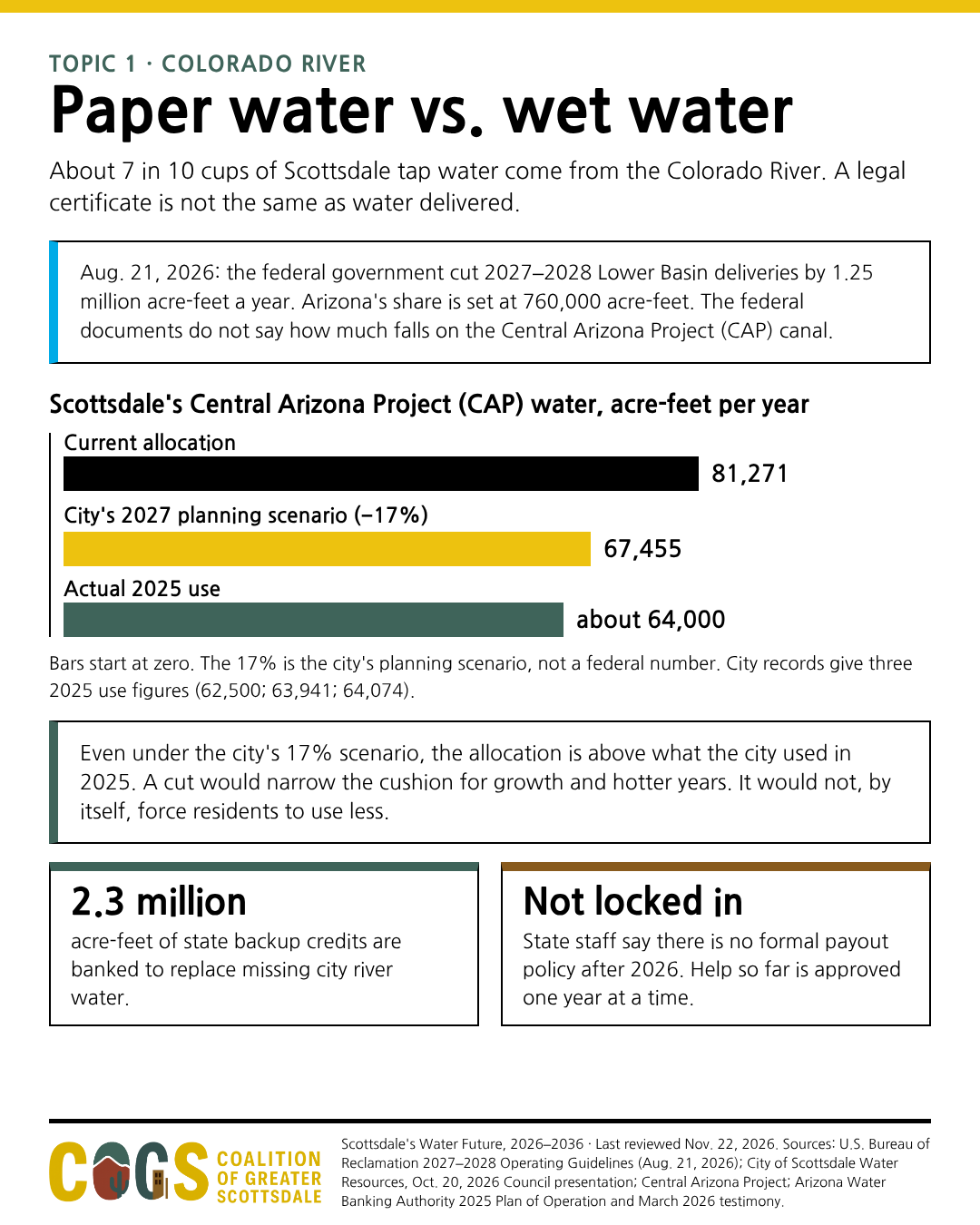
- The federal rules have been issued. On August 21, 2026, the Bureau of Reclamation issued its Record of Decision and the first set of Operating Guidelines. For 2027 and 2028 they cut deliveries to the Lower Basin states by 1.25 million acre-feet a year. Arizona’s share is set at 760,000 acre-feet (California 440,000; Nevada 50,000). The framework runs through 2036, with new guidelines issued in two-year sets; reductions for 2029 and later have not been set.
- The federal documents do not say how much falls on the Central Arizona Project. Arizona’s 760,000 acre-feet has to be divided among its water users, and the guidelines give no figure for the Central Arizona Project (CAP) canal. The 17% below is the city’s own planning scenario, not a federal number.
- Most of our water is river water. About 70% of everything Scottsdale delivers (about 75% of its drinking water) comes from the Colorado River through the CAP canal. With Salt River Project (SRP) water, roughly 90% of the drinking-water supply is surface water.
- “Paper” vs. “wet” water. Scottsdale’s Designation of Assured Water Supply (141,341.74 acre-feet a year in the city’s October 2026 presentation) is a legal certificate. When the river runs low, holding a certificate doesn’t automatically mean physical water comes out of the tap.
- What a cut would mean in numbers:
| Figure | Acre-feet per year |
|---|---|
| Scottsdale’s current CAP allocation | 81,271 |
| City’s 2027 planning scenario (a 17% reduction) | 67,455 |
| Scottsdale’s actual 2025 CAP use | about 64,000* |
| 2025 drinking water delivered (CAP + SRP + groundwater) | about 82,600–84,100 |
| 2025 reclaimed water delivered (not drinking water) | about 8,200 |
| Total water delivered, all sources including reclaimed (2025) | about 90,800–92,300 |
*City records give three slightly different 2025 CAP figures (62,500; 63,941; 64,074) and two slightly different totals, a minor internal inconsistency. The “drinking water” and “reclaimed” lines are shown separately because reclaimed water does not come from the CAP or SRP and is not part of the drinking supply.
Because 2025 CAP use was already below the planning-scenario allocation, a cut of that size would not by itself force residents to use less than they do now. But the cushion is thin. As a rough check using the city’s own figures: if CAP were cut to 67,455, and SRP and groundwater delivered what they did in 2025 (about 12,700 and 7,400), drinking-water supply would be about 87,500 acre-feet against about 82,600–84,100 of use, a cushion of roughly 3,400 to 5,000 acre-feet (about 4% to 6%). That is COGS’s arithmetic, not a city figure. It assumes SRP and groundwater keep delivering at 2025 levels and that CAP deliveries rise to the full reduced allocation. The cushion shrinks if either falls short or demand grows.
What’s Still Open
- Why many see reasons for confidence. Scottsdale holds 52,810 acre-feet of municipal CAP subcontracts plus a long-term tribal lease (28,406 acre-feet with the Fort McDowell Apache Nation). Cities and tribes hold higher legal priority than agriculture, so Scottsdale sits near the front of the delivery line. The Arizona Water Banking Authority (AWBA) holds more than 2.3 million acre-feet of underground credits meant to replace missing city river water.
- Why others see limits. In March 2026, AWBA staff told state lawmakers the agency “currently has no formal firming policy for post-2026 distribution” to CAP cities. Its help so far has been approved one year at a time.
- The cuts could grow. The 2027–2028 guidelines call for further consultation if Lake Mead is projected to fall below 1,010 feet, and Reclamation’s framework models shortages far larger than 1.25 million acre-feet. Both Lake Mead and Lake Powell reached record-low levels in August 2026.
- No more banking surplus. In past years the city stored leftover river water underground. After 2026, there will be no extra river water left over to store.
- Different percentages, different bases. Cut figures in the news and elsewhere measure different things (all of Arizona’s Colorado River supply, the CAP canal’s supply, or one city’s share). Check which one a number refers to before comparing it with another.
What It Means for Residents
- A total supply failure is unlikely, but the safety net is still being put in place.
- A 17% CAP cut wouldn’t change what residents use today. It narrows the margin for growth.
- Replacing river water with newer supplies, such as purified recycled water, costs more per acre-foot than today’s sources (see Topic 3). Water rates rise 4.5% on November 1, 2026; the city’s budget presentation says 1 percentage point of that is to help fund additional water sources and supply. The city has not published a rate forecast for the decade.
Still being confirmed: (1) how Arizona’s 760,000-acre-foot reduction is divided between the CAP canal and other water users, and whether the city’s 17% planning scenario reflects the final federal guidelines; (2) which usage figure is the city’s planning baseline, since its own documents give slightly different 2025 CAP-use and total-delivery figures (COGS has asked); (3) how much SRP and groundwater the city can count on after 2026. COGS will update this section as these are answered.
Sources: U.S. Bureau of Reclamation, 2027–2028 Operating Guidelines; U.S. Bureau of Reclamation, Future Colorado River Operations Fact Sheet; City of Scottsdale, “Scottsdale evaluating impact of new Colorado River rules”; City of Scottsdale, FY 2026/27 proposed rate and fee changes (Council, Mar. 3, 2026); Central Arizona Project, “Colorado River Operations”; Arizona Water Banking Authority, 2025 Plan of Operation; Morrison Institute for Public Policy, ASU; City of Scottsdale Water Resources, Oct. 20, 2026 Council presentation. Last reviewed: November 22, 2026.
Topic 2
Harquahala Groundwater: Moving Rural Water Through the Central Arizona Project Canal
Scottsdale bought water rights about 100 miles away hoping to move that water through the Central Arizona Project (CAP) canal to its golf courses. The canal’s water-quality rules, treatment costs, and an unsettled price tag decide whether, when, and at what cost that can happen.
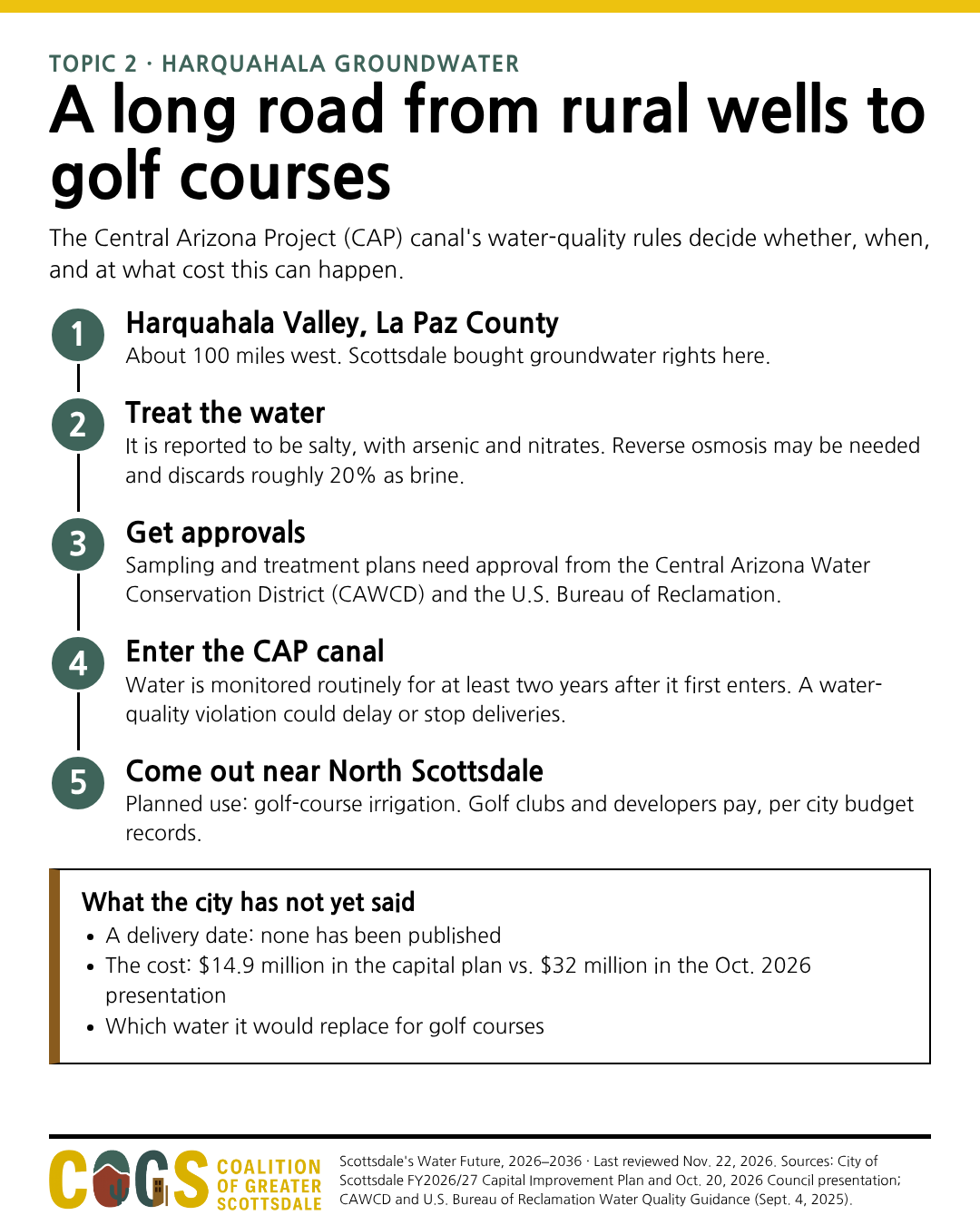
Scottsdale bought groundwater rights in the Harquahala Valley in rural La Paz County. The plan is to put that water into the CAP canal and take it out near North Scottsdale to irrigate golf courses. The canal operator sets strict limits on anything added to the canal, and Harquahala groundwater is reported to be salty with arsenic and nitrates, so it may need costly treatment first. No delivery date has been published. Treatment, approvals, and a monitoring period of at least two years are all part of the process. According to city budget records, golf clubs and developers, not water customers, are paying. What residents can’t yet know is when the water will flow and what the project will finally cost. The city has cited both $14.9 million and $32 million. The city has also not said which water supply Harquahala water would replace for golf courses, so COGS makes no claim yet about a benefit to residents.
Go Deeper
Where Things Stand
- The plan. Under Resolution 13702, Scottsdale bought groundwater rights in the Harquahala Valley, about 100 miles west of the city. Through a city project (WH16, renumbered PW2116 this year), it plans to drill wells, put that groundwater into the CAP canal, and pull it out in North Scottsdale for golf-course irrigation.
- The canal’s entry rules. In September 2025 the Central Arizona Water Conservation District (CAWCD), which operates the canal, and the federal government adopted water-quality guidance for non-project water. It sets limits at the point water enters the canal and across the system. Water over the limits has to be treated first, typically with reverse osmosis, which discards roughly 20% of the water as salty brine.
- Approvals and monitoring. Each source well must be sampled, and sampling and treatment plans need approval from CAWCD and the U.S. Bureau of Reclamation. After the water first enters the canal it is monitored routinely for at least two years.
- Who pays. Scottsdale Water took part in writing the CAP’s non-project-water rules to protect its own wheeling rights, and city contracts require golf entities, not taxpayers, to pay cleanup, testing, and canal-toll fees. According to city budget records, golf clubs and developers pay construction, treatment, and canal-toll costs, not water-rate revenue.
- State law. A.R.S. § 45-554 explicitly allows moving water out of the Harquahala basin under these rules.
- No delivery date. COGS did not find a published date for first delivery. Summer canal congestion or a water-quality violation could also delay or stop deliveries.
- The cost is not reconciled.
| Source | Figure |
|---|---|
| City’s FY2026/27 adopted capital plan (project PW2116) | $14,891,400 over five years |
| City’s Oct. 20, 2026 presentation to Council | “$32 million current cost estimate” |
The city’s public documents do not explain the gap. Early estimates for projects that are not yet designed commonly change, especially when construction costs are rising, so a different number is not surprising in itself. The open question is why the city has not explained the difference. Residents should treat $32 million as the more recent number, not yet a reconciled one.
What’s Still Open
- Water from outside the already-stressed Phoenix-area aquifer is a possible additional supply, and some residents see that as a reason to proceed.
- The treatment, approval, and monitoring steps could add cost and delay, and some residents want those resolved before the project is treated as a model for future transfers.
- The city has not said what water Harquahala water would replace for golf courses, so its benefit to residents is unknown.
- A stalled or costlier project would leave the golf courses looking for other water. COGS did not find a public analysis of how that would affect the city’s reclaimed supply.
- The two cost figures above have not been reconciled.
What It Means for Residents
- The project’s value depends on whether the canal’s entry rules, treatment costs, and monitoring can be handled at a workable price.
- According to city budget records, golf courses and developers carry the cost. Residents can ask the city to name the water Harquahala water would replace before any benefit is claimed.
Still being confirmed: (1) why the capital plan and the October presentation show different costs; (2) the date of first delivery; (3) what water this would replace for golf courses.
Sources: City of Scottsdale, FY 2026/27 Adopted Capital Improvement Plan (project PW2116); Central Arizona Water Conservation District & U.S. Bureau of Reclamation, “Water Quality Guidance for the Introduction of Non-Project Water into the CAP” (Sept. 4, 2025); Arizona Revised Statutes § 45-554; City of Scottsdale Water Resources, Oct. 20, 2026 Council presentation. Last reviewed: November 22, 2026.
Topic 3
High-Tech Water Recycling and Golf-Course Water
Scottsdale is studying whether to turn treated wastewater into drinking water, an option that would add a few percent to the city’s supply at a much higher price, and the city has not yet decided to build it.
Scottsdale is studying advanced purification, which would turn its own treated wastewater into drinking water. The city hasn’t decided to build it, and no design or construction date has been set. Staff are expected to bring a cost analysis and recommendation to the City Council after feasibility studies finish. At the sizes the city has priced, it would add about 2% to 3% of the water Scottsdale uses in a year. That wouldn’t replace river water from the Central Arizona Project (CAP) canal, but it would be a local supply that doesn’t depend on any river. The technology is well established, though some residents feel uneasy about it, and it costs more than ten times as much per acre-foot as the water Scottsdale treats today. The same treated wastewater now goes largely to underground recharge and golf-course irrigation under long-term contracts, and COGS has not seen those contract terms. (How the city budgets for this and other unfinished projects is covered in Topic 4.)
Go Deeper
Where Things Stand (as of November 22, 2026)
- Not yet decided. The city has not approved building an advanced purification facility. A May 2026 city news release calls it a long-term strategy, says feasibility studies are underway, and says staff will return to Council “within six to nine months” after they are complete with “a complete cost analysis and recommendation”. COGS did not find a published design or construction date.
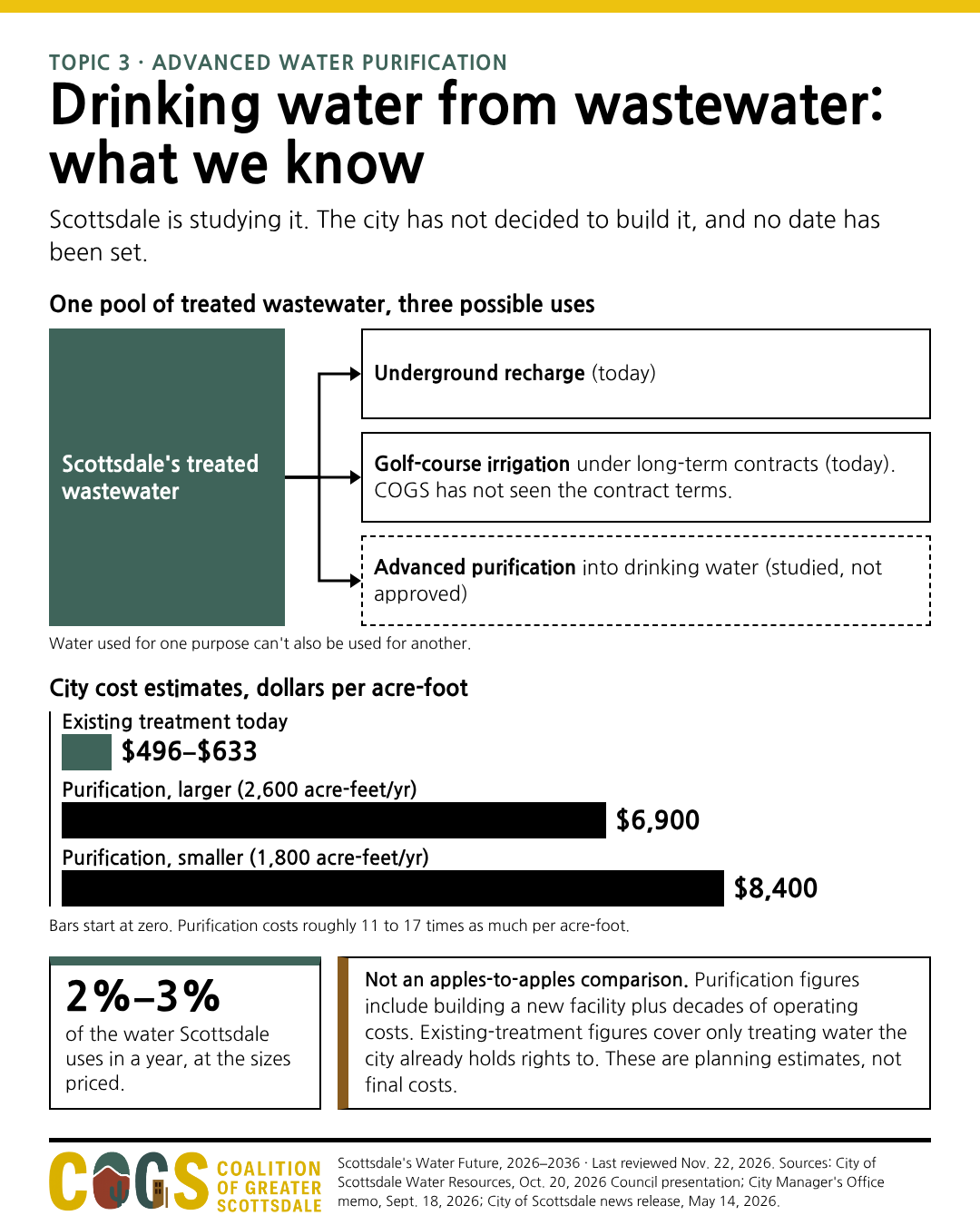
- Two sizes priced. The city’s October 20 presentation priced a smaller facility (1,800 acre-feet a year) and a larger one (2,600). By COGS’s arithmetic from the city’s figures, that is about 2% to 3% of the roughly 90,000 to 92,000 acre-feet the city uses in a year, and about 13% to 19% of the 13,816-acre-foot reduction in the city’s 2027 planning scenario for CAP supply (see Topic 1).
- What it would not do. It would not replace CAP.
- Other new supplies also have long timelines. The same city release lists three storage-and-recovery wells “expected to be operational by 2029.” It says Harquahala groundwater acquisition is “advancing” and the Bartlett Dam expansion “has entered the federal environmental review process,” with no dates for either.
- Why it matters, and why it may not yet. On the city’s own figures, 2025 CAP use was already below the 2027 planning-scenario allocation (see Topic 1), so there is no immediate shortfall. The gap matters if cuts deepen or demand grows.
- A limited permit already exists. In 2019 Scottsdale received Arizona’s first permit for direct potable reuse (ADEQ permit R-512974). The city and the Arizona Department of Environmental Quality both describe its use as limited, at the Scottsdale Water Campus. COGS found no permit for putting purified water into the city’s drinking-water system; as far as can be confirmed, that is a future step.
- Public comfort. Some residents are uneasy about drinking recycled water. The city has held public tastings of beer brewed with purified water since 2019 to build comfort with the idea.
Cost per Acre-Foot
The city’s own October 2026 analysis puts a full-scale advanced purification facility at $6,900 to $8,400 per acre-foot, depending on size. That is roughly 11 to 17 times the cost of the water Scottsdale treats today.
| Purification, smaller (1,800 acre-feet/yr) |
Purification, larger (2,600 acre-feet/yr) |
Existing treatment (CAP, groundwater, current plant) | |
|---|---|---|---|
| Cost per acre-foot | $8,400 | $6,900 | $496–$633 |
Note: this is not an apples-to-apples comparison. The purification figures are a lifecycle average that includes building a new facility from the ground up, plus decades of operating costs. The existing-treatment figures cover only treating water the city already holds rights to and already has the infrastructure to deliver. COGS has not confirmed the assumptions behind the purification figures with city staff, so treat them as a planning estimate, not a final cost.
This is not a bill multiplier. New supply would be blended with the city’s existing, cheaper water, so the effect on the average rate would be smaller than the per-acre-foot gap suggests. The city has not published a rate impact, so how much smaller is not yet known.
Golf Courses, Treated Wastewater, and What Isn’t Known
Treated wastewater is not a new source. Today most of it goes to underground recharge or to North Scottsdale golf courses under long-term contracts. The purification facility would take the same treated stream, so the two uses draw on the same limited pool. COGS has not seen the contract terms. Whether the city must deliver a fixed amount to golf courses, and what happens in a shortage, are open questions for Scottsdale Water.
What’s Still Open
- Purified water would be a local drinking supply that doesn’t depend on any river or the CAP canal, and Scottsdale has run a small demonstration purification program since 2019. Some residents see that as a reason to move forward.
- Filtering wastewater with reverse osmosis is expensive, and household water softeners add salt to sewage, which raises filter-replacement costs. Some residents want the cost and design settled before the city commits.
- Waiting for firm design and regulatory requirements before committing could avoid building the wrong thing at the wrong size (see Topic 4).
- The cost is a planning estimate, and no design or construction date exists, so residents can’t yet judge the price against the benefit.
- CAP’s water-quality guidance says CAP and the U.S. Bureau of Reclamation “will not consider projects” whose source water is treated effluent until there is “at least five years of operational experience with introduction of other supplies” and a required review of the standards. The guidance doesn’t say when that period starts.
What It Means for Residents
- Advanced purification could give Scottsdale a very safe, self-reliant supply, but as of late 2026 it is a goal in progress, not a finished system.
- Residents can ask Scottsdale Water how golf-course contracts and a purification facility would share the same treated water, and what happens in a shortage.
- To keep operations affordable, the city encourages residents to switch away from salt-based water softeners.
Still being confirmed: (1) the date and terms of the final ADEQ permit (the city and ADEQ say it was issued in 2019, but COGS has not located the final permit document); (2) how the city’s $232 million and $277 million present-worth estimates relate to other reported cost figures, and how the per-acre-foot figures compare with purification costs other utilities have published; (3) when the five-year period begins and how it is counted; (4) whether the feasibility studies are complete and when staff will make a recommendation; (5) golf-course contract delivery and shortage terms.
Sources: City of Scottsdale, Advanced Water Purification; City of Scottsdale news release, May 14, 2026; City of Scottsdale Water Resources, Oct. 20, 2026 Council presentation; Central Arizona Water Conservation District & U.S. Bureau of Reclamation, “Water Quality Guidance for the Introduction of Non-Project Water into the CAP” (Sept. 4, 2025); Arizona Department of Environmental Quality, reclaimed water permit R-512974; Arizona Department of Environmental Quality, Advanced Water Purification FAQ. Last reviewed: November 22, 2026.
Topic 4
How the City Budgets for Unfinished Water Projects
In June 2026 the City Council took $233 million in water projects out of its five-year capital budget. The city says it is waiting for firm costs; critics say residents lose sight of what is coming.
Cities publish a multi-year capital plan that lists big projects and what they are expected to cost. In June 2026, the Council removed $233 million in water projects from Scottsdale’s five-year plan and declined a separate $20 million request for advanced purification and well drilling. City officials say a project that is not yet designed or fully approved shouldn’t carry a guessed number, and that new state testing standards will likely affect costs. Critics say it puts off hard decisions and makes it harder for residents to see what is coming. The city’s own Budget Review Commission asked the city to address how this year’s method leaves out most costs of projects that haven’t been fully scoped. Water work is still funded: the adopted FY2026/27 budget has about $331 million for water and water reclamation projects.
Go Deeper
Where Things Stand
- The vote. At its June 9, 2026 meeting, the Council removed $233 million in water projects from the five-year Capital Improvement Plan (CIP) and declined a separate $20 million request for advanced purification and well drilling.
- Water work is still funded. The city’s June 12 release says the adopted FY2026/27 budget includes about $331 million for water and water reclamation projects, and more than $855 million over five years for water and wastewater infrastructure.
- A city commission raised a concern. The Budget Review Commission voted 6–0 on March 9, 2026 to ask the city to address the sustainability of its five-year capital plan, noting that this year’s method leaves out most costs of projects that haven’t been fully scoped. At that meeting, staff said advanced purification was excluded “due to the uncertainty of budgetary impacts,” and a motion to include a placeholder died for lack of a second.
- Follow along. The Budget Review Commission’s page is at /brc/.
Making the Case
The case for the city’s approach
- City management says removing unfinalized placeholders prevents budgeting artificial numbers before engineering designs and final costs are done.
- A city spokesperson said the change provides “flexibility while ensuring future investments are guided by the best available technical, regulatory and financial information,” citing new Arizona Department of Environmental Quality (ADEQ) testing standards for purified-water facilities that will likely affect project costs.
The case for more caution
- Civic critics and former councilmembers argue that removing $233 million in water projects “put off” hard decisions during an election year.
- They say the loss of detailed, line-item visibility makes it harder for residents to track what is and isn’t funded year to year.
- The city’s own Budget Review Commission raised the same kind of concern about the plan’s method.
What a Professional Standard Says
COGS has not found a government, academic, or think-tank source that says whether leaving an unscoped project out of a capital plan is usual. The Government Finance Officers Association (GFOA), a professional association for public finance officials, publishes guidance that points in both directions. It does not mention placeholders or say whether an unscoped project should be listed or left out.
- Toward the city’s approach: GFOA says “the scope and timing of a planned project should be well defined in the early stages of the planning process,” that a plan should be “achievable within expected available resources,” and that the final plan should be based on “what can realistically be funded”.
- Toward the critics’ concern: GFOA says “unfunded projects should be summarized,” and that an exceptional capital presentation “enhances the transparency and accountability to citizens”.
What It Means for Residents
- Removing a line from the plan doesn’t by itself mean money was lost or diverted. It does mean the plan shows less about what is coming.
- Watch for when advanced purification and related projects return to the capital plan, and for the staff cost analysis described in Topic 3.
- Residents can ask Scottsdale Water in writing when the project would re-enter the plan and what changed in this year’s method.
Still being confirmed: (1) the breakdown of the $233 million; (2) when the project would re-enter the capital plan; (3) the city’s written explanation of the method change.
Sources: City of Scottsdale, Proposed Capital Improvement Plan (2026); City of Scottsdale City Clerk, June 9, 2026 Council meeting transcript; City of Scottsdale news release, June 12, 2026; City of Scottsdale Budget Review Commission, minutes, March 9, 2026; Government Finance Officers Association, Multi-Year Capital Planning, Capital Budget Presentation and Capital Planning Policies. Last reviewed: November 22, 2026.
This guide reflects the best publicly available information as of November 22, 2026. It does not take a position on the underlying policy debates; it aims to give residents accurate, sourced, plain-language facts so they can form their own views. Prepared for the Coalition of Greater Scottsdale (COGS).
Looking for the history of the river? Read Arizona and the Law of the River, COGS’s advocacy page on how the river is governed.
See something that looks wrong or out of date? Email us and we will check it against the source.
 JOIN/RENEW/DONATE